Sgt. David R. Wallace writes from Italy, October 1944
On October 25, 1944, Sgt. David R. “Ronny” Wallace wrote from Italy to Hollywood actress Virginia De Luce asking for an autographed photograph. His letter appeared in excerpt in “Dear Virginia,” a feature in America in WWII’s fall 2015 special issue Stars in WWII, Volume II. The feature credits collector Darrell English. The 455th’s roll call lists David R. Wallace as a sergeant in the 742nd Bomb Squadron, matching the name, rank and unit printed with the letter. Published letter excerpt · 455th Bomb Group roll call.
Photographs of the 455th’s Arlington memorial
J. Makali Bruton photographed the 455th’s memorial at Arlington National Cemetery on October 10, 2016. One view shows the installed bronze plaque and its inscription. The other shows the memorial tree and marker from Roosevelt Drive. View both photographs and the location map · 455th memorials and dedication history.
Photograph of the 455th’s Dayton memorial
William Fischer Jr. photographed the 455th’s plaque at the National Museum of the U.S. Air Force on March 5, 2010. The plaque bears a 1988 dedication date and names all four of the group’s squadrons. View the installed plaque and its inscription · 455th memorials and park directory.
Big Time Operator and the reported landing at Bari
The fall 2005 Cerignola Connection account of 741st radio operator and gunner Angelo Marcotrigiano describes a damaged B-24 using parachutes to slow its landing at Bari. The account gives the aircraft as 42-78504 and associates the incident with Mission 198 over Moosbierbaum. The Army Air Corps Museum indexes that serial under MACR 7456 for a 454th Bomb Group aircraft piloted by John Mason on August 17, 1944. A Bulgarian loss table also lists Mason, the serial and report number, and places the loss at Lik near Mezdra. The 455th’s history records its Mission 198 on February 20, 1945 against the shipyards at Trieste. The serial and mission date for the reported Bari landing remain unresolved. Marcotrigiano account · MACR 7456 catalog · Bulgarian loss table, entry 87B · 455th mission history.
Buzz Job, B-24G 42-78435
A wartime photograph shows Buzz Job on the runway with parachutes trailing from the fuselage. The tail serial and aircraft number 32 agree with the 741st Bomb Squadron’s aircraft inventory. The caption indexed by B-24 Best Web identifies Capt. Bill R. Adams as pilot and says the crew used the parachutes to slow the bomber after its hydraulic system was damaged over Budapest. The date and original photograph credit remain unverified. Photograph · Catalog caption · 741st aircraft inventory.
Albert A. Lundwall, 740th Bomb Squadron pilot
The 1937 Rutgers yearbook, The Scarlet Letter, prints a senior portrait of Albert Arnold Lundwall. He studied education and played football and lacrosse throughout his four years at Rutgers. The university’s World War II memorial traces his path through training at Davis-Monthan and Langley and into the 740th Bomb Squadron. Rutgers yearbook and portrait (PDF, page 74) · Rutgers memorial biography.
Missing Air Crew Report 4021 identifies Lundwall as the pilot of B-24H 41-29296. The aircraft was lost in a midair collision over the Adriatic on March 19, 1944. The report includes eyewitness statements and a sketch showing where Lundwall’s aircraft was last seen. Missing Air Crew Report 4021 (PDF).
Albert N. Edelstein, 742nd Bomb Squadron co-pilot
The University of Maine’s veterans memorial includes a portrait of Albert Nathaniel Edelstein, Class of 1943, and traces his path from college to B-24 training and service with the 742nd Bomb Squadron. In a December 28, 1944 letter home to Sanford, Maine, he told his family he had nine missions left to fly. The Journal Tribune published an excerpt and described a photograph of him leaning out of his aircraft. University of Maine memorial and portrait (PDF, page 91) · Newspaper account and letter excerpt
Missing Air Crew Report 10749 lists Edelstein as co-pilot of B-24J 42-51935 on the December 29, 1944 mission to Udine. He bailed out and was injured. The casualty record gives December 30 as the date he died. An Army Air Corps Museum award-card transcription records an earlier Purple Heart under Order 28, dated September 18, 1944. Missing Air Crew Report 10749 (PDF) · Purple Heart award-card transcription
Cherrie, 742nd Bomb Squadron B-24J 42-51332
World War Photos has a wider version of the in-flight photograph of Cherrie in the 455th’s aircraft gallery. The 742nd Bomb Squadron inventory identifies it as B-24J 42-51332, aircraft No. 43. The photograph’s date and mission are unknown. Wider photograph · Aircraft gallery and nose art
William C. Lazenby’s family mission list records him aboard ship 332 on August 27, 1944, on the 455th’s Mission 104 to Blechhammer. In the fall 2013 Cerignola Connection, Wayne Griffin reported having photographs of his father, Lloyd M. Griffin, beside Cherrie and a group photo with Virgil Epperson. Lazenby family mission list · Griffin family letter
James D. Naler’s crew photograph, 742nd Bomb Squadron
The fall 2000 Cerignola Connection printed the same crew photograph twice. Page 14 asked readers to identify the navigator and bombardier, and page 4 gave their surnames as “Donelon” and Drummond. A family caption indexed by B-24 Best Web supplies their full names. Navigator Paul R. M. Donelan is at the far left in the back row, and bombardier John A. Drummond is third from the left. The outside catalog credits the photograph to Paul Donelan and lists his wife, Jerre Donelan, as the contributor. Crew photograph and caption, page 14 · Alternate caption, page 4 · B-24 Best Web catalog entry
The 742nd’s July 21, 1944 mission completion report spells the navigator’s surname Donelan and lists Drummond as bombardier. On that mission both flew aboard ship 989, with Lt. Swanner as pilot, Lt. Naler as co-pilot, and the six enlisted men pictured in the crew photograph. The photograph’s date remains unknown. July 21, 1944 mission completion report
Robert Kratz’s flak-damaged cap
The National Museum of the U.S. Air Force documents a cap that 455th Bomb Group B-24 bombardier Robert Kratz was holding when a fragment passed through it. The museum credits Kratz with 52 combat missions, and the 455th roster lists him in the 740th Bomb Squadron. The date and aircraft associated with the incident remain unidentified. Air Force museum artifact record · 740th Bomb Squadron roster
William Beck and The Cowtown Blonde photograph
The Alamo Heights WWII Honor Roll identifies 1st Lt. William A. Beck Jr. as the man standing in the center of a photograph beside The Cowtown Blonde. The same photograph appears in the 455th association’s fall 2015 newsletter, where Robert Hardy’s son identifies his father at the left of the standing row and says he flew with Lt. William King’s crew. The photograph’s date and complete lineup remain unverified. Missing Air Crew Report 5459 identifies Beck as pilot of B-24H 42-52282 when it was lost near Bor on May 6, 1944. The honor roll also reproduces the grave marker naming Beck and six crewmates. Alamo Heights Honor Roll and photographs · Fall 2015 newsletter photograph · Missing Air Crew Report 5459 (PDF)
Fubar and the crash near Volders
B-24H 42-64482, Fubar, of the 742nd Bomb Squadron was lost on June 13, 1944. Keith Bullock’s Tirol crash register places the loss at Großvolderberg, near Volders. Gerald Aichner’s local account includes an eyewitness recollection of the crash. Missing Air Crew Report 5812 is the group’s wartime record of the loss. 742nd aircraft inventory · Tirol crash register · Local account · MACR 5812
Steyr on April 2, 1944
The 455th attacked the bearing works at Steyr on April 2, 1944. A study by Fritz Müller, available through the Steyr city archive, describes the raid and damage from the city’s perspective. The account complements the 455th’s mission history and unit citation. 455th group history · Unit citation · Fritz Müller’s study, printed pages 30–33
Patrick J. Chaisson’s Hell at 21,000 Feet, published in the winter 2025 issue of WWII History, recounts the April 2 raid and includes 455th veterans’ recollections of the first months at San Giovanni. Tail gunner Henry B. Everhart recalled the rain and mud, then the larger tents and communal shower the men set up among the olive trees. A photograph in the article is captioned as Sgt. Edward Vigil pointing out where he used a glove to stem a hydraulic leak. The original photo credit and aircraft identification remain unverified. Read the article and view its photographs.
Craiova on June 24, 1944
Alexandru Daneș examines the three American raids on Craiova in May and June 1944, including their effects on the city. The study reproduces the 455th Bomb Group’s Field Order 71, dated June 24, in an appendix credited to the group’s website. Article abstract · Full study and field order, printed page 141
Linz on April 25, 1945
For its final combat mission, Mission 252, the 455th attacked the main railway station and marshalling yards at Linz. The Linz city archive describes the same day from the ground, including the air-raid warnings and the aftermath of the city’s last major bombing raid. 455th mission history · Linz city archive account
Maribor on March 1, 1945
The 455th sent two forces toward the Maribor marshalling yards on March 1. On Mission 207, weather blocked the primary target. Eleven aircraft bombed Jesenice and seven made no drop. The group history records that the later force, Mission 208, reached Maribor and observed bomb strikes in the target area. A study by Vladimir Prebilič and Lara Iva Dreu gives local context for the raids. 455th mission history · Slovenian Digital Library study
San Giovanni airfield
The 454th and 455th Bomb Groups shared San Giovanni airfield near Cerignola. In his study of the Bradford Archive’s aerial photographs, Mike Seager Thomas identifies three 455th tent camps west of the runways near San Giovanni in Fonte and 454th camps around Posta Incorvera. The study reproduces a photograph of the field dated April 29, 1945. 455th group history · Bradford aerial survey, printed pages 50–53
Rex Melton, a pilot in the 454th Bomb Group’s 739th Bomb Squadron, recalled two parallel runways at San Giovanni with steel matting at the ends and gravel between. He placed the shared control tower on the 455th side of the runways and described gravel hardstands and taxiways. Read Melton’s account in his autobiography, hosted by Penn State.
Wartime Cerignola and the shared airfield
The Comune di Cerignola hosts Gli Americani a Cerignola, Giovanni Montingelli’s 2002 catalog of Mario Capocefalo’s photographic exhibition. Capocefalo recalls local workers, the chapel, tent camps, and support buildings at San Giovanni in Zezza. The catalog reproduces wartime photographs. Municipal catalog (Italian)
Ray’s Story, a family history of Raymond Zisk of the 454th Bomb Group’s 737th Bomb Squadron, includes an aerial photograph, views of the 454th headquarters, and a map tracing the old airfield layout. It identifies the western runway with the 455th and the eastern runway with the 454th. Read Ray’s Story, printed pages 24–26
Gettysburg College’s Albert Chance collection lists photographs of Cerignola from July 1944. Local historian Geppe Inserra identifies four views dated July 11, including the cathedral, a fountain scene, and a demolished bridge. Albert Chance collection finding aid · Photo descriptions (Italian)
The November 2, 1944 streamer ceremony
Erik Goldstein’s Ray’s Story reproduces the 454th Bomb Group’s account of a joint citation ceremony at San Giovanni on November 2, 1944. Personnel from the 454th and 455th assembled between the runways, where Maj. Gen. Nathan F. Twining attached streamers to the group banners. The book includes a photograph of Twining at the presentation, credited to Paul Johnson. Read the account and see the photograph on pages 43–44.
Wartime film of the 304th Bomb Wing
The Sons of Liberty Museum catalogs a 116-minute compilation of Army Air Forces camera footage covering the 454th, 455th, 456th and 459th Bomb Groups. The listing includes B-24s at San Giovanni and other wing bases. Full viewing is offered by subscription. The public listing gives an overview of the compilation. View the museum’s film listing.
Bucket O’ Bolts crew photograph
Photo 7 in Gli Americani a Cerignola shows a 455th crew and maintenance personnel at San Giovanni in Zezza. It is a wider crop of the photograph published in the Fall 2014 Cerignola Connection. In the newsletter, Patrick R. Campbell identifies his great-uncle, 740th Bomb Squadron Lt. J. T. Ward, as second from the left in the standing row. The 740th aircraft inventory lists two B-24s that carried the name, 42-52190 and 42-50400. The aircraft serial in this photograph remains unverified. Municipal catalog, photo 7 · Newsletter photograph and family identification · 740th aircraft inventory
Bernard Bloom and the Snook crew
The 455th Bomb Group Association’s fall 2015 newsletter identifies Bernard Bloom as the right waist gunner in a photograph of Lieutenant Darrell G. Snook’s crew. The same photograph appears in the existing Bloom gallery. The 743rd Squadron’s October 11, 1944 loading list places Sgt. B. Bloom with Snook and the other men pictured, aboard aircraft 655. Bernard Bloom gallery · Fall 2015 newsletter · October 11 loading list
The spring 2001 association newsletter credits Snook with bringing Tepee Time Gal home from its 100th mission. The group history dates that milestone to February 22, 1945, at Linz. The February 22 loading list assigns Snook to ship 889 and Lt. D. Gill to ship 583. Bloom’s name does not appear in either entry. The crew photograph establishes Bloom’s association with Snook, while Bloom’s presence on Tepee Time Gal on that sortie remains unconfirmed. Spring 2001 newsletter · Group history · February 22 loading list · Aircraft 41-29583
Seymour Gaynes and the name Tepee Time Gal
Seymour “Sy” Gaynes, a navigator in the 743rd Bomb Squadron, recalled that David G. Bellemere’s crew took over B-24H 41-29583 after a replacement crew brought it to Italy. The aircraft arrived with nose art and the name Wattacrok. Gaynes said the crew kept the artwork and renamed the bomber Tepee Time Gal with help from a squadron photographer who was also an artist. Near his station on the right side of the nose, the crew painted a Star of David and his nickname, “Sammy.” Gaynes’s recollection, reproduced with photographs · Aircraft 41-29583 photographs
Leakin’ Deacon in a July 1944 newspaper
The July 14, 1944, Albany Democrat-Herald reported Daniel J. Neuman’s promotion to captain and the loss of his 743rd Bomb Squadron B-24, Leakin’ Deacon. The newspaper drew on letters that relayed Neuman’s account. He was on leave when another crew took the aircraft on the mission from which it failed to return. Missing Air Crew Report 5839 identifies Almon E. Catlin’s crew aboard B-24H 41-29271 on June 9, 1944. Wartime newspaper scan · Loss report and place notes · Ledbetter’s recollection and Neuman crew photograph
Emmett Ledbetter, Neuman’s flight engineer and top turret gunner, received the Distinguished Flying Cross in February 2003. Tennessee Senate Resolution 94 describes the wartime incident behind the award and names ball turret gunner Reid B. Peck, who helped Ledbetter. The 455th association newsletter records Peck’s own award later that year. Tennessee Senate Resolution 94 · Spring 2004 Cerignola Connection
The Vulgar Vulture insignia correspondence
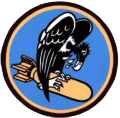
The May 2020 451st Bomb Group Newsletter reproduces Walt Disney Productions letters to Viola Crowell dated August 3 and August 20, 1943. The August 20 letter says Major Philip P. Crowell requested a group insignia and designs for four squadrons. The studio proposed using the group design for all four, with a different bomb color for each squadron. Historian John Rohrer’s accompanying account leaves the origin of the idea open. Read the correspondence and Rohrer’s account.
455th mechanics at Prkos
In March 1945 the 455th was one of five bomb groups that supplied a combined 60 mechanics to the Allied emergency landing field at Prkos, near present-day Zadar, Croatia. Mike Croissant cites the 81st Air Service Squadron’s March history and reproduces an Air Force Historical Research Agency photograph of a B-24 under repair at the field. The article gives the combined total for the five groups. Read the Prkos account in Air & Space Power History.
The Moosbierbaum citation in the wartime press
The May 24, 1945, issue of Texas A&M’s The Battalion reported that Brig. Gen. William D. Hall attached a blue battle streamer to the 455th’s standard at its base in southern Italy. The article identifies Lt. Col. Philip J. John as group executive officer and connects the second Distinguished Unit Citation to the June 26, 1944, mission against the Moosbierbaum refinery. Read the wartime newspaper · Read the citation
The Moosbierbaum refinery before and after the raids
Austria’s Federal Environment Agency traces the history of the Donauraffinerie, known as DORA, at Moosbierbaum. The plant expanded in 1941–42 to produce high-grade aviation gasoline and synthetic lubricants. Repeated bombing in 1944–45 heavily damaged the complex. The repaired refinery reopened in 1946 under Soviet administration, which operated it until 1955. Figure 3 marks the former refinery and tank farm on a June 2000 aerial photograph. The report describes damage across several raids. Austrian site history and maps (PDF)
How the Butch the II crash photo circulated
James H. Reeves submitted a print of the San Giovanni crash photograph to the Second Air Division Association’s journal in 2004. He credited Sterling A. Bryant of the 740th Bomb Squadron as the source of his copy. The print matches the photograph of B-24M 44-50468 after its April 12, 1945 takeoff accident. Reeves’s letter gives seven deaths. The wartime accident report records six. Reeves’s letter and photograph · Accident report · Original print in the 455th collection
Bud Markel of the 827th Bomb Squadron also recalled seeing the wreck from the road while heading toward Foggia with Ralph Johnson. His account appears with a reproduction of the photograph in The Torretta Flyer. Read Markel’s account.
Bill Disbrow’s search for his 741st crewmates
In the February 1987 issue of Air Force Magazine, Bill L. Disbrow recalled piloting the B-24 Organized Confusion and asked readers for help locating six men he had flown with in Italy in 1944. He named John E. Merfeld, Herbert B. Cornell, Robert L. Caldwell, Kenneth J. Vincent, James E. Weeks and Don Keegan. A separate 455th association account places Disbrow with Harold Gorski’s crew on the June 26, 1944, Moosbierbaum mission. The aircraft serial and the crew for any individual sortie need separate confirmation. Disbrow’s letter · Spring 2010 Cerignola Connection
Alfred Asch and the 455th records at Knoxville
Tennessee House Joint Resolution 349 recounts Alfred Asch’s work training the newly formed 455th, his wartime service with the group and his later work on its published history. It also records his donation of 455th research material to the University of Tennessee, Knoxville. The university’s finding aid lists mission files, photographs and veterans’ recollections in the collection. Tennessee House Joint Resolution 349 · 455th Bomb Group Records finding aid
In collection CSWS-0440, Box 1, Folder 8 is dated May 7, 1945. Box 2, Folder 3 lists wartime orders and enlistment records, Folder 7 lists mission data dated 1996, and Folders 16–21 cover the four bomb squadrons’ papers. Box 4 lists the August 28, 1943 issue of the Alamo Blockbuster and a file of German flak position maps dated June 1992. The university stores the collection offsite and asks researchers to request material in advance. Box 1 inventory · Box 2 inventory · Box 4 inventory
Robert Cook and the April 20, 1944 San Giovanni rescue
A Military Order of the Purple Heart profile recounts how 743rd Bomb Squadron pilot Robert L. Cook brought his damaged B-24 back to San Giovanni on April 20, 1944. Cook was trapped after the aircraft crashed and caught fire. The profile describes how 741st Bomb Squadron flight surgeon Harold F. Schuknecht pulled him from the cockpit with help from navigator David Woodlock. It also includes Cook’s recollection of the rescue. Read Cook’s profile.
In the 455th association newsletter, Col. Horace Lanford records that Schuknecht received the Soldier’s Medal for pulling Cook from the wreck. A memorial published by the American Otological Society includes a portrait and documents Schuknecht’s later career at Harvard Medical School and the Massachusetts Eye and Ear Infirmary. Lanford’s account · Schuknecht memorial and portrait
Andrew Klopchin’s return to Sofia
In a letter published by the 99th Bomb Group Historical Society, former prisoner of war John R. Lees recalled flying back to Sofia in late September 1944 with Sgt. Klopchin. Lees described the trip as part of a U.S. inquiry into the treatment of Allied airmen held in Bulgaria. Andrew G. Klopchin’s obituary records his captivity in Bulgaria, and a Purple Heart award card lists him with the 743rd Bomb Squadron in September 1944. The aircraft he was aboard when captured remains unverified. Read Lees’s letter · Purple Heart award card · Klopchin’s obituary
Maynard Post, squadron clerk and trombonist
The June 8, 1944, Berrien County Record describes Staff Sgt. Maynard A. Post as a squadron headquarters chief clerk in southern Italy. A trombonist before the war, Post played with other musicians in a tent in an olive grove near the airfield. The 455th roll call lists him with the 740th Bomb Squadron. The newspaper later printed an August 17, 1945, letter from Post to his parents. 1944 newspaper profile · 1945 letter home
Alamogordo Army Air Base
The Air Force unit history lists Alamogordo Army Air Field, New Mexico, as the 455th Bomb Group’s first station on June 1, 1943, followed by Kearns, Utah, and Langley Field, Virginia. A wartime Alamogordo photo booklet, dated circa 1944 by the Army Air Forces Collection, shows B-24s parked below Old Baldy Mountain, a B-24 in the sub-depot hangar, and other base facilities. The booklet’s captions identify the scenes at Alamogordo. The units of the pictured aircraft are unverified. Air Force unit history · Photo booklet catalog entry · View the wartime booklet (PDF)
Kearns and Langley Field
The Air Force group history places the 455th at Kearns, Utah, in September 1943 and at Langley Field, Virginia, in October. Photographs reproduced by the Deseret News from the William Anderson scrapbook and a Camp Kearns officers’ roster booklet show the camp gate, barracks, and mess hall. At Langley, NASA photo EL-2000-00233 shows a B-24D used by the National Advisory Committee for Aeronautics outside the Army Air Forces airship hangar in July 1943, before the 455th arrived. Camp Kearns photographs · NASA’s Langley B-24D photograph
Karl T. Feuerriegel, 741st Bomb Squadron pilot
The Luke Army Air Field Class 43-K yearbook identifies Karl T. Feuerriegel of Phoenix, Arizona, in the second portrait from the left on the “Maintenance” page. The Hall of Valor transcribes his Distinguished Flying Cross citation under Fifteenth Air Force General Orders No. 1571, dated March 20, 1945. The citation identifies him as a first lieutenant and pilot in the 741st Bombardment Squadron, 455th Bombardment Group. Cadet portrait (yearbook PDF, page 33) · Distinguished Flying Cross citation
Millard Dean and Menacing Messalina
Staff Sgt. Millard Hilton Dean Sr.’s family obituary identifies him as a B-24 engineer and gunner in the 743rd Bomb Squadron. It recalls that he flew in the nose and ball turret and associates his service with Menacing Messalina. His son also described a now-missing photo of Dean and his crew beside the aircraft in a letter to Cerignola Connection. The Everything B-24 catalog shows a nose-art photograph and identifies the aircraft as 41-28665. The available photograph shows the nose art. Dean’s crew photograph remains unlocated. Dean family obituary · Nose-art photograph and catalog caption · May 15, 1944 accident report for 41-28665 (PDF)
The 743rd’s March 2, 1944 loading list assigns Dean to the ball turret on ship 665. It names Orville I. Lee as pilot, Charles A. Denton as co-pilot, and Joseph M. Collins as top-turret gunner, confirming the three crewmates Dean’s son named. The loading list gives the ship number. The full serial attribution for the nose-art photograph still comes from the outside catalog. March 2 loading list (PDF)
Lawrence Bruni and the Pittsburgh Babe crew
The Brookline War Memorial profile of 2nd Lt. Lawrence A. Bruni traces his training and arrival in Italy with S. W. Siegel’s crew in the 743rd Bomb Squadron. It includes a portrait of Bruni, a partial mission list, and a group photograph captioned as the flight and ground crew of Pittsburgh Babe, with Bruni standing second from the left. The 455th squadron history also identifies Bruni, navigator Ned Paul, co-pilot James Shuster and pilot S. W. Siegel together in an eight-man crew photograph. Brookline War Memorial profile and photographs · 455th squadron history (printed page 244)
On August 26, 1944, Bruni and Paul flew with Lt. Col. Hugh Graff aboard B-24H 41-28862. Graff’s statement in Missing Air Crew Report 8086 records a direct flak hit on the flight deck and places Bruni at the radar equipment. The report records Paul’s return to Allied lines on September 13. Missing Air Crew Report 8086 (PDF)
Sanford Jones’s interview at age 100
In an Eastern Kentucky University interview, 740th Bomb Squadron gunner Sanford L. Jones Sr. dated his crew’s 35 combat missions from November 16, 1944, to April 18, 1945. He also recalled how the GI Bill helped him enroll in college in 1946 and begin a career in education. Eastern Kentucky University interview · Sanford Jones in Stories