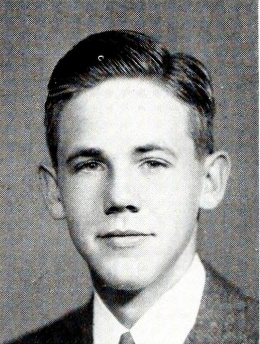
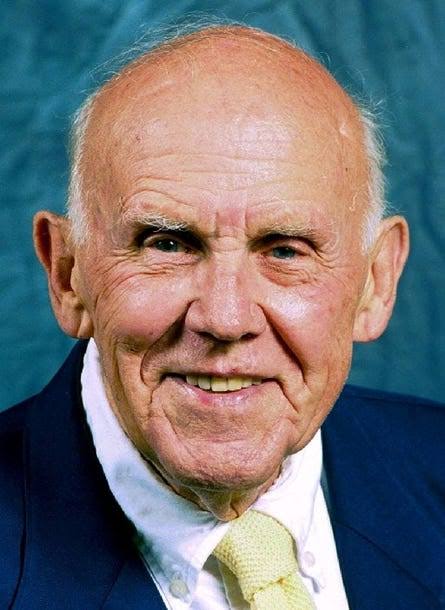
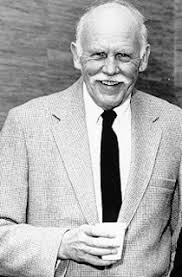
James H. Shumaker
740th Bomb Squadron · Radio operator and gunner
Scans contributed by Chip Pearsall
Wartime service
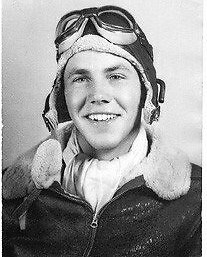
James Hampton “Jim” Shumaker (1923–2000) grew up in Durham, North Carolina. He joined the 740th Bomb Squadron in July 1944. On July 22, his B-24 Liberator, 42-50424, collided with B-24H 42-95328 of the 741st Bomb Squadron during a mission to Ploiești. Shumaker was the only survivor from his aircraft.
German forces captured him, and he spent the rest of the war as a prisoner, including time at Stalag Luft IV. He returned to the United States in 1945.
After the war, Shumaker became a newspaper editor and taught journalism at the University of North Carolina at Chapel Hill.
Firsthand accounts
Shumaker’s 1993 interview
Speaking with Perry Deane Young, Shumaker recalled bailing out after the collision, his capture and detention in Tirana, and the fear of hearing Allied bombers while locked in a POW railcar. Read the interview transcript in INDY Week.
A flight-school story
When Chip Pearsall was a journalism student, he and his classmates asked Shumaker about his wartime service. Shumaker told them that, during flight training in Texas, he had progressed to flying without an instructor aboard. On one practice flight, he was at the controls of a two-seat trainer with another student beside him when he decided to fly just a few feet above a quiet highway.
As Pearsall remembers the story, a passenger bus approached from the opposite direction. The driver steered into a field, where the bus tipped onto its side. Shumaker said he could see passengers writing down the aircraft number as he passed. By the time the students landed, word had reached his command. Shumaker told the class that he was dropped from flight training and sent to gunnery school.
In a 1984 Duke Chronicle profile, Shumaker also recalled passengers taking down the aircraft number. In that telling, the bus went onto the shoulder.
Six columns from The Charlotte Observer
Shumaker’s wartime recollections appeared in The Charlotte Observer and were collected in Shu (Citizen Publishing, 1989).
Select a title to read the full column here. The transcriptions come from scans contributed by Chip Pearsall. Bracketed page numbers refer to Shu, and brackets also mark unclear readings.
A much-decorated soldier
February 6, 1983 · Shu, pp. 146–147
[p. 146]
—Declined Flying Cross…
James Garner, the actor, and I have a thing in common, far-fetched though that might seem.
The thing is the Purple Heart, considered by many of us to be the most exalted of America’s military decorations. The medal itself is heart-shaped, purple on a gold base, with a raised likeness of George Washington in heroic profile — in a word, striking, although it doesn’t coordinate well with an argyle sweater.
The back of the medal says, “For Military Merit.” Theoretically, you have to be wounded in combat to get one.
Garner was decorated with his Purple Heart a couple of weeks ago, the pinning being done with regular military honors. He was wounded 32 years ago while serving in Korea as a combat infantryman, known as James Bumgarner at the time. The Army often works in mysterious ways, accounting for the 32-year delay.
As Garner explained it, he was running south in Korea from enemy fire and dived head first into a foxhole. A bullet got him in the back of the lap, he said, putting it delicately.
My own military merit, attested to by the Purple Heart, was almost as glorious. I was decorated toward the end of World War II by an old friend, Buddy Douglas, a supply sergeant in the Quartermaster Corps at Fort Bragg.
A bunch of us, fresh out of prisoner-of-war camps in Germany, were being re-outfitted at Fort Bragg before going home for rest and rehabilitation.
Buddy loaded me down with khakis, olive drabs, shoes and the like. He tried to fit me with an officer’s blouse but I was afraid that might be awkward, my being a Pfc. Then he said, “Okay, now what medals do you need.”
I said I would take one of those Good Conduct Medals, figuring to make my mother swell with pride. I also picked a European Theater of Operations ribbon, to which I was clearly entitled, having been over there.
Buddy insisted on my taking a Unit Citation, on grounds that even if I hadn’t done anything noteworthy, somebody in my outfit possibly had. The dark blue ribbon added a nice touch of color to the khakis, so I let him pin
[p. 147]
one on me.
I also accepted pilot wings, bombardier and navigator wings and a captain’s bars, not to wear but as keepsakes and for post-war dating purposes.
To my everlasting credit, I drew the line at the Distinguished Flying Cross. Buddy said, “What the heck, you rode in a plane, didn’t you?” I said, yes, as a radio operator-gunner, never once firing a shot in anger.
When we got around to the Purple Heart, Buddy said, “You must have got hurt over there.” I said no, not really, unless you counted losing substantial weight and missing regular dental care.
Buddy said, “Didn’t they bang you around, hit you in the stomach or something like that? Fellow just came through here got punched at an interrogation center and I awarded him the Purple Heart.”
When the planes collided, I explained carefully, trying not to sound heroic, my machine gun tore loose from the moorings and swung around and hit me in the head.
“Knock you out?” Buddy asked. “You bleed any?”
I might have shed a drop or two, I conceded. The main thing I got was a terrible headache.
“Well, there you are,” Buddy said. “Here’s your Purple Heart.” He pinned it on me himself and gave me a nice simulated leather case to keep it in when I wasn’t on parade.
“The trouble with some of you guys,” Buddy said, “is that you’re too doggone modest for your own good.”
The wings and captain’s bars have gotten away through the years, but I am still hanging onto the Purple Heart, for the grandchildren to admire. I expect James Garner will do the same.
2/6/83
Finding mule’s place at the table
December 2, 1984 · Shu, pp. 151–152
[p. 151]
Have a bite of ‘Old Maude’…
Now, with the turkey reduced to hash and Christmas menus being planned, is a good time to consider mule meat, a favorite entree of the besieged and desperately hungry.
The mule has an honored place in North Carolina, although not on the dinner table. Benson, in Johnston County, holds an annual Mule Day when this beast of intolerable burdens, including denial of parenthood and conjugal pleasures, is showered with appreciation. Ironically, the celebration takes place hard by I-95, along which traffic flies and no sensible mule would tread.
The mule’s place in Southern history is fixed and secure, largely in the diary of John D. Austen, the Confederate chief telegrapher at Port Hudson, the South’s last Mississippi River stronghold in the Civil War. The diary recently was presented to the state of Louisiana by Austen’s descendants and is available for public consumption.
A memorable passage in the diary was entered on Port Hudson’s 43rd day of siege by the Yankees. All of the meal, rice, bacon and lard were gone by then, and the gallant defenders were casting about for something to eat. That’s when the lowly mule won its place in Confederate history.
“This day we had mule steak for dinner for the first time,” Austen wrote. “I partook of it most heartily, and indeed found it good. It is equal at least to the poor quality of beef which we sometimes have been compelled to eat.”
Port Hudson surrendered five days later, having held out for nearly a week longer than Vicksburg, probably on the strength of the mule meat.
I have to go along, up to a point, with John Austen’s assessment of mule
[p. 152]
meat as table d’siege. It is indeed edible, if a trifle chewy and on the sweet side. In texture and taste it can’t compare with roast cat, but is more filling. Mule sticks to your ribs, as Granny used to say of oatmeal, while cat qualifies practically as an hors d’oeuvre.
My first encounter with mule as table fare was 40 years ago when I was under siege by the Germans. Well, not exactly under siege; I was in a German prisoner-of-war camp. The fare was skimpy, depending heavily on German bread, made of sawdust and spread with denatured axle grease, and ersatz coffee, made from burned peanuts.
The arrival of the mule, on a flatbed truck, hooves sticking straight up, ready for butchering, was greeted with cheers and sustained applause, the sort of jubilation that attends the presentation of a particularly fine animal in Benson on Mule Day.
We didn’t get steaks, there being about 1,000 of us having to make do with one mule. So, I can’t speak with authority on that particular cut. We had a fine mule stew, garnished with a dehydrated German vegetable that turned black in water.
At times these days, dining in one of Chapel Hill’s standard eating places, I look back on that mule stew with a certain longing.
The roast cat came later, at another prison camp, and was as much a lark to break the monotony as it was a game effort to ease the hunger pains.
A couple of light-hearted souls caught the stray cat, fed it for several weeks on whatever was at hand, toning up the flesh the way you top off a steer, and then held a cat roast. There wasn’t enough for a genuine cat pickin’; it was more of a tasting, like at a Tupperware party. Once you get over the idea, cat isn’t half-bad.
Still, everything considered, I’ll take mule. There is something warm and intimate, if not altogether elegant, in saying, “I believe I’ll have another helping of old Maude there.”
12/2/84
Recalling a dismal winter
February 10, 1985 · Shu, pp. 154–156
[p. 154]
Vignettes of a stalag…
One winter we were in a stalag outside Kiefheidi, a village near the Polish border, and the weather, like the quarters, was less than charming.
In the barracks, each room housed 16 prisoners and was heated by a small coal stove. The daily ration of fuel was 16 bricks of coal, one per man.
During the day, when we could move about the compound and work up body heat, the fire was banked and kept barely alive.
In the long stretches of the night, when the cold settled in and movement about the room was severely restricted, we would rise stiffly from the floor mats from time to time and huddle in turn about the tiny stove, rubbing and beating to get the circulation going.
In the steel-gray days, when the sky seemed as low as our spirits, touch football and running, an ungainly and panting version of today’s jogging,
[p. 155]
helped to ward off the cold. Partly because of that winter, I suppose, I still can’t look at a jogger pumping along in Adidas and a designer sweatsuit and Walkman earphones without instant revulsion.
One of the educated among us figured out, possibly by touching his hand to his scalp, that an enormous amount of body heat was lost by not wearing a hat. And suddenly, knit caps began appearing all over the compound.
An enterprising group was turning sweaters into headgear, filling orders through an unravelling and knitting operation. Depending on the design, two or three caps could be produced from a long-sleeved sweater. A deluxe model, with bill, earflaps and chin strap, went for 20 cigarettes plus the yarn.
Among many valuable lessons in that winter of despair, I learned that lice were far better able than I was to withstand the bitter cold. Once in a while, to break the monotony and with illusions of becoming lice-free, I washed my clothes and hung them outside to freeze-dry.
Once the clothes had frozen stiff, in a couple of hours or so, not a louse could be found anywhere, in the seams or snuggled in a cuff, not even a nit. I rejoiced in the thought that I would be sleeping and walking around in my clothes without company for a while.
Then, as soon as the clothes thawed and before I could even get them on again, there those little devils would be, scampering along the inseams, whetting their appetites. They went with me all the way into France and finally said goodbye when I headed for Le Havre; they might have gone on to Paris.
One of the lighter moments in that miserable winter came with the arrival of a bomber crew still wearing khakis and Florida suntans. The crew had ditched in the Atlantic when the plane developed engine trouble.
A German sub plucked them from the briny and they were deposited in our little compound, their plans for gamboling on Miami Beach gone terribly wrong.
The winter outside Kiefheidi eventually laid me low in an unexpected way. The final blow came during one of my futile attempts at delousing.
A surprise roll-call — one of the Germans’ continuing efforts to discover contraband — caught me with my clothes frozen stiff. After I stood for an hour in ankle-deep slush without socks or pants, my feet turned Carolina Blue.
Chafed and toasted by the little coal stove, the feet still refused to function properly. Not even the lice would have anything to do with them. I
[p. 156]
spent the rest of the war peeling my feet and stomping them for circulation.
Since then I have never taken winter weather seriously, especially not in North Carolina, although I still grouse about sleet from time to time, mainly to make conversation.
2/10/85
It won’t kill you, we hope
April 9, 1975 · Shu, pp. 156–157
[p. 156]
And it might help…
At the time, we were huddled together, an ailing mass yearning to breathe free, in an army barracks with inside plumbing and other comforts of home, like bunks and windows.
The Russians were coming, and on one of the last nights we could hear the rumble of explosions in the distance and scatterings of small-arms fire. It didn’t take a general to figure out that the situation was becoming fluid.
The main body of prisoners, about 10,000, had already been evacuated. Those of us in the barracks had been culled out because we were unable to march. We had pneumonia or frostbite or appendicitis or whatever. A few through some stroke of genius were managing simply to dog it, a risky business but worth it if you didn’t get caught.
Most of the German soldiers had marched out with the main body leaving the camp deserted except for our little enclave. The German soldiers’ barracks that we were in now had been converted by voice command into a field hospital. “Achtung. This barracks is now a hospital.” Like that. That’s how we came to be enjoying the comforts of home.
The hospital facilities were makeshift and the medical supplies scanty. There was one doctor, an American captain with frostbite so painful that he could barely hobble about.
Despite the medical shortages and his own physical discomfort, the captain’s professional approach was lighthearted, some would say devil-may-care. He performed an appendectomy on a wooden table at one end of the barracks using a pocketknife for a scalpel and common thread to sew up the incision. During the operation the captain smoked a black cigar that he had scrounged somewhere, hummed and whistled and was generally jolly throughout. When he had tied the last knot with a grand flourish and cut the
[p. 157]
thread, he smiled at one of the “medics” holding the patient down and said cheerfully, “Take a look at what I cut out and see if it was an appendix.”
A good many concluded that the captain wasn’t exactly all there, which wouldn’t have been unusual in that time and place. From then on when he asked how they felt, they would either shrink back or laugh and shout, “Fine, Doc, fine,” and try to put on a healthy face.
Another time, the captain came upon a prisoner writhing on the floor. The poor fellow was clutching his stomach and between gasps pleading for help.
The captain gazed at him for a minute. In the circumstances this amounted to a careful diagnosis. He took a bottle of pills from his hip pocket, frowned in puzzlement at the label, and removed the cap and sniffed. Then he shook out a handful of pills, gave them to the fellow on the floor and said with a happy chuckle, “Take these. I don’t know what they are, but if they don’t kill you they might help you.”
As it turned out, the pills didn’t kill the poor fellow and eventually his stomach cramps went away. For all I know he’s still living.
I can’t say what happened to the captain when the war wound up. There was a terrible mix-up right there at the end and it was headache enough just getting back to the proper country, much less trying to keep track of what happened to everybody else.
If I had to make a guess, I would say the captain eventually got out of medicine and has become an academic or maybe a newspaper editor.
4/9/75
POW license plate? — No thanks!
October 15, 1975 · Shu, pp. 159–160
[p. 159]
Although Ike said it was okay…
The word from the Department of Motor Vehicles that all of North Carolina’s ex-prisoners of war are entitled to special license plates has got me torn in the worst kind of way.
The license plates will be red, white and blue and will be permanently assigned to those eligible and applying. Ex-POWs can switch the plates if they trade cars, a real convenience.
The reason I am torn is that the last thing in the world I want to advertise is that I am an ex-prisoner of war. I have been trying for 30 years now to live that down. I don’t mind listening to war stories and I am certainly glad that the Allies won, but beyond that I try not to say much.
Riding around with a red, white and blue license plate created especially for ex-POWs would make about as much sense in my case as wearing a Stalag 3 monogram sweater or having Kriegsgefangenen tattooed on my forearms.
I have been letting the POW part of my past lie fallow since May, 1945, when General Dwight Eisenhower dropped in on some of us for a little repatriation pep talk.
About 10,000 of us were at Camp Lucky Strike, one of the centers on the Cherbourg peninsula in France where POWs were being herded together as they drifted out of Germany. Even after being de-loused, trimmed, outfitted and put on regular rations, we were still a pretty scruffy lot. Extended time
[p. 160]
in a POW camp tended to leave you a trifle worn around the edges.
Eisenhower flew in from his headquarters to welcome us back to allied control and wish us bon voyage to the states. Ike’s syntax wasn’t any better when he was a general in the field than after he became President, and he was in right much of a hurry that day, too, blurting his speech. I figured he was anxious to get on into Paris.
As I understood him, Ike said that it was all right for us to hold our heads up even though we had laid down our arms in the face of the enemy. The war was over anyway and nobody was going to go on blaming us for surrendering. I got the idea that the welcome back to allied control was something less than a hot embrace.
In the case of the fellow next to me, leaning on his crutches to hear Ike speak, he had laid down his arms, along with one leg and his right eye, when his B-17 exploded 24,000 feet over Berlin. Trying to buck up his spirits, I told him, “You hear that, boy? Ike says it’s okay for you to hold your head up.”
I have been plagued ever since with feelings of guilt about laying down my arms. When children ask me how it was in the war, I always tell them I still can’t bear to talk about it. I had an uncle who used to say the same thing when I asked him about World War I. It turned out that he had been a cook in Texas and the only shooting he ever got close to was in a [road house?] near Fort Worth.
That’s why I’m planning to pass up the special red, white and blue license tag, even though I’m clearly eligible. I hope the Department of Motor Vehicles will understand; I don’t want to seem ungrateful.
10/15/75
POWs had Christmas spirit
December 18, 1974 · Shu, pp. 167–169
[p. 167]
Despite stark setting…
Nobody asked me, unless you count the radio announcer who called bright and early and said in dulcet tones, “Would you like to recall for our listening audience, sir, the most memorable Christmas you ever had?”
Having a somewhat strangled public-speaking voice and not being given to talking on the telephone any more than is necessary, I declined to recall.
Later on I felt a twinge of guilt. After all, this is the season of giving, and what could be more generous and warm-spirited than sharing one of my Christmases past. What indeed?
Memorable is not the right word for it. Vivid would be better, or maybe stark.
It was 30 years ago, in 1944. There were about 10,000 of us, a motley collection of Americans, Canadians, English, South Africans, Scots, Sons of Eire, with a few Russians thrown in for an Asiatic touch.
The camp was near the village of Kiefheidi, 90 miles northeast of Berlin. It consisted of roughly 10 acres enclosed by fences and barbed wire, with guard towers at regular intervals.
During the summer several hundred of us had lived in tents while more barracks were being built. When the Baltic winter began settling in, we
[p. 168]
moved inside and that was a comfort of sorts.
The holiday season was formally opened with a visit by Max Schmeling, the former world heavyweight champion. He had become a gentleman farmer after retirement from the ring and was the most affable German, the only affable German, we had run into.
A bold spirit among us shouted, “Wait’ll Joe Louis gets hold of you again,” and Schmeling covered his head with his arms and then joined in the laughter. Nobody could figure out what Max Schmeling was doing touring POW camps. The way the war was going, it would have made more sense for him to be spreading Christmas cheer among German troops. Though puzzled, we accepted his visit with good grace and wished him a Merry Christmas.
Christmas itself that year was what others would call scrimpy and forlorn. It was fat and joyful by our everyday standards.
A Christmas gift shop did a brisk business in one of the barracks. Some ingenious souls had unraveled sweaters and used the yarn to knit a striking array of caps. There were hand-carvings, paintings, hand-tooled leather goods, and unaccountably, an assortment of jellies and jams. The gift shop proprietors refused to say how the jellies and jams got in there. Free enterprise manages to survive all kinds of adversity. The medium of exchange was that universal wartime currency, cigarettes.
A few days before Christmas we were sent through the Germans’ private wash house and luxuriated for once in showers and then were given a change of clothes. Later on we learned that this was for the good of the Fatherland, not a Christmas present to us. They wanted our uniforms to use in the Battle of the Bulge, not knowing that then, it was nice just to be shed of the lice for a while.
Early Christmas morning two trucks came into our compound and headed for the cook shack. We counted 16 legs sticking up and a great cheer arose. We figured to be eating high on the horse that day — four horses. And we did.
The Germans threw in a few extra loaves of ersatz bread, a strange concoction with the texture of sawdust; extra ersatz coffee, a brew that tasted like burned peanuts; and extra measures of an exotic seaweed soup. I nearly foundered myself.
That afternoon the Germans released some of our mail, not the packages, of course, just letters. Those who didn’t get any, which was most of us, read other people’s with great interest.
[p. 169]
Before they locked us up and brought in the dogs for the night, the C Compound Christmas Carolers went from barracks to barracks singing those fine old Yuletide standards. The carolers weren’t Fred Waring’s Pennsylvanians, but they had practiced hard and were pretty good.
When they went into “Silent Night” a lot of grown men swallowed hard and looked away or studied the ceiling. After the carolers finished there was nose-blowing all over the place.
The spirit of Christmas might have seemed incongruous in that place where life was cheap, surrender to animal instincts easy, and the constant concern mere survival. But it came, and in a way it was amazing.
Personally, given a choice, I prefer the kind we have now.
12/18/74
Original scans
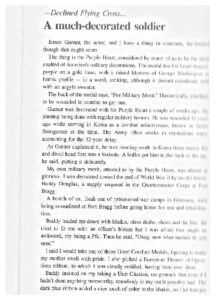 A much-decorated soldierFebruary 6, 1983 · Shu, pp. 146–147Shumaker remembers his return to Fort Bragg and tells how he came to wear a Purple Heart after the collision.Read PDF
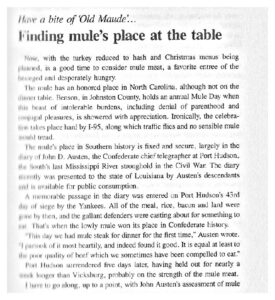 Finding mule’s place at the tableDecember 2, 1984 · Shu, pp. 151–152A mule delivered to a POW camp breaks the monotony of prison rations and prompts a reflection on wartime hunger.Read PDF
 Recalling a dismal winterFebruary 10, 1985 · Shu, pp. 154–156Shumaker describes how prisoners coped with the cold, lice, and frostbite during the winter of 1944–45.Read PDF
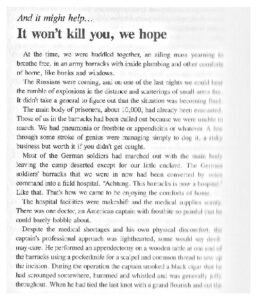 It won’t kill you, we hopeApril 9, 1975 · Shu, pp. 156–157As Soviet forces approached, an American doctor improvised care for prisoners too ill to march out of camp.Read PDF
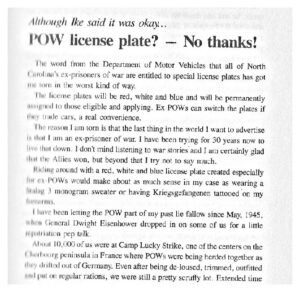 POW license plate? — No thanks!October 15, 1975 · Shu, pp. 159–160A proposed special license plate brings back Shumaker’s memories of returning to Allied control at Camp Lucky Strike.Read PDF
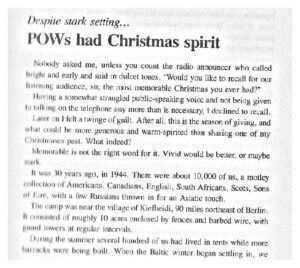 POWs had Christmas spiritDecember 18, 1974 · Shu, pp. 167–169Shumaker recalls Christmas 1944 in captivity, from an unexpected visit by Max Schmeling to a chorus of “Silent Night.”Read PDF
Download the reviewed transcription of all six columns (PDF)
View Transcription of Shumaker’s six wartime recollections on this page
Other photographs